About Yogini Linda Madani
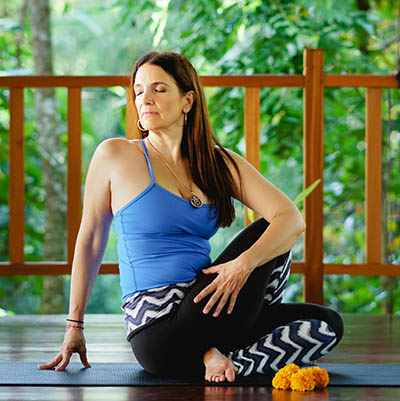
My name is Linda Madani (born Linda Grondin) and I have the good fortune to lead yoga classes on the island of Bali, in Indonesia. I am a registered yoga teacher with the international Yoga Alliance (E-R.Y.T 500), a certified yoga therapist both from India and USA, as well as a spiritual healer. I am also a Certified Yoga Therapist (C-IAYT) with The International Association of Yoga Therapists (www.IAYT.org)
I teach Yoga Pranala a combination of Asana, Pranayama, Meditation, Mudra Pranala(Balinese qi gong) and Yoga Nidra to students in either English, French, Indonesian or Mandarin. A student of a Balinese shaman Cokorda Rai since 1996, I integrate the knowledge that I have received from my teacher into my own teachings.
It is with great pleasure that I share my web site and open my heart to all of you. This site is dedicated to all of you who are committed to the path of self-healing.
My Mission
For me yoga is a form of spiritual development, which fortifies our physical, emotional, mental and spiritual body. It’s not about religion but about connecting with our divine self. The divine is interpreted in many outer forms according to the different cultures within the different religions. In yoga we learn to connect our individual consciousness to the source. Yoga is complementary to any religion. Yoga is a safe place where we can all unite.
I usually start my yoga class with a practice of mudra pranala (Balinese qi gong/energy work) to train my students to switch from thinking to sensing. In a yoga pranala practice we merge our left brain functions of intellect and individual will with our right brain functions of receptivity, intuition and instinct.
The practice always begins by opening one’s heart. Only when the heart is open can the energy flow into the body and we can connect with our divine consciousness. We learn to feel, to follow and to channel the energy in our body by increasing our sensibility to the energy of mother-earth (feminine, negative) and to the energy of the universe (masculine, positive). The fusion of both poles manifests itself inside the body as prana: the life force energy. Prana and energy movements are essential for healing mind, body and spirit. In Balinese lontars, pra means first, prana power, nala inner fire and pranala circulation.
At first, it is the mind that leads the energy but eventually it is the energy that leads the mind. Once we become sensitive to the energy and allow it to flow, our life also begins to flow. There is harmony, peace, and tranquility for those who dare to go inside of themselves. We just have to be aware, to understand and to know that the divine already exists within each of us.
When our physical, emotional, mental and spiritual bodies are in alignment, we are healthy. Energy blockages in any of these bodies cause illnesses. When the different bodies are in balance, one has limitless health and energy. We need to tap into the self-healing wisdom within the energy fields of our different bodies but most importantly, we need to anchor our consciousness into the earth plane.
Yoga teaches us to go beyond our limits. As we stretch our muscles past our limit, we learn that we can go beyond the limits we have set ourselves in our life, beyond the limits of the 5 senses mind. This is the journey that I have set for myself and I wish to invite you to take it with me.
My Journey
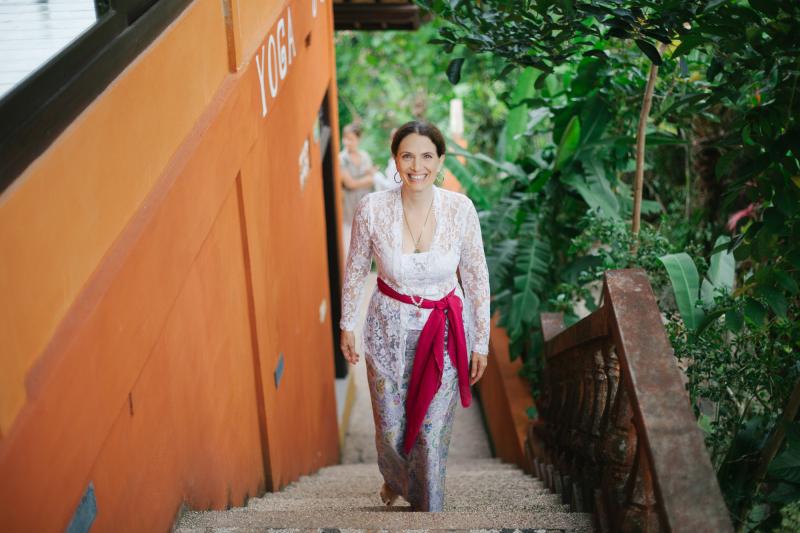
Becoming a yoga teacher came to me unexpectedly. Although I was a yoga practitioner, it had never crossed my mind that someday I would become a yoga teacher. One day a friend of mine won a scholarship to become a yoga instructor. It was at this point that I knew it was what I needed to do next.
I always knew that my mission in life was to help other people. Although it was a strong calling, somehow at the beginning, I was afraid. Yet, it was the most natural thing for me. All my life I was at service but something was missing. I had no boundaries and people took advantage of me.
It’s only when I understood that being at service didn’t mean being a servant that I could be a true healer. When I understood this: doors opened in front of me and my direction in life became very clear.
I’m on a spiritual path. I don’t pretend to be ahead. There is no order of things on the path. We are each other’s teachers. My students are my teachers. They help me to go further on my path.
Having said that, through the years, I feel that I have made my way to a very comfortable place, a place where I love being me, a place where I am in love with myself. Along the way I had all sorts of experiences that made me who I am now and many more will come. I do not worry; I welcome new experiences because I see them as learning experiences. As we are being tested, we learn and grow.
In the 90′s, I moved to Taiwan where I studied Mandarin at Tunghai University for one year and then for the next few years I worked as an English teacher in a private school. My years in Taiwan were very pleasant. I had good fortune. Looking back at it, I realised that in my profession as an English teacher I was utilising my skills as a healer.
A lot of the students that came to my classes were young men and women with low self-confidence. For some reason, I attracted these kinds of students.
I realized very quickly that I had the ability to give these people self-confidence. For those who were even less self-confident, I would put them in a little bubble and attach the bubble to my heart and forget about them and just go on with my teaching. I have no idea where I got this idea. It just came naturally to me. I could see without doing anything special these students metamorphosing themselves as the class progressed. Light would come into their eyes. Even their complexion looked clearer. It’s as if I was putting light into them. What is interesting is that this was happening without me really trying. It just came through my intentions.
After five years, I still loved being in Taiwan but something was pushing me out. My life felt incomplete. I decided to travel for a while and to make my way down to Australia from Thailand. During that time I traveled through Thailand, Malaysia, Singapore and Indonesia. I was struck by the different interpretations of the divine in the different cultures. Witnessing all these different manifestations of the divine made me realize that there had to be a God. The divine just came in different packages according the different interpretations of the different cultures.
When I arrived to Bali, I was, like everyone else’s, overjoyed by the beauty and the energy of the island. I had just read Paolo Coelho’s The Alchemist. In the book the Alchemist says to the little shepherd: “When you really want something the universe conspires to make it happen.” I would go to the rice field and yelled, “I want to stay here for ever.”
I did end up staying in Bali. Only later did I understand that we can indeed force our will to obtain something we really want but since we don’t have the whole picture we may be hindering the cosmic plan and limit our own possibilities.
During my first year, I was doing meditation and practicing yoga daily. Very quickly I had a streak a good luck. I found a job, a boyfriend, a nice little studio and a beautiful little kitten named Black Magic. I thought that I couldn’t possibly desire anymore. I was so grateful that I decided to surrender every thing to God in my meditation. I don’t remember how this came to my mind but I surrendered my job, my boyfriend, my studio and my kitten.
Within a week I had lost everything. I was in shock. I knew I had gotten God’s attention but I didn’t know what it meant. I was scared but I knew deep inside that I had done the right thing. I never doubted that. I had really no one to talk to. It was the beginning of my spiritual journey.
One month later, I had a new job; much better than the previous one, a new house, a new boyfriend and a cat came into new my house and gave birth to five kittens. I had everything and more.
You see, I had limited myself in the past. What I had previously I had thought was the best that I could desire. But God had better plans for me and when I surrendered to him, I went beyond my five-sense mind and attracted more than what my mind had previously restricted me to.
Only later, when I had read Marianne Williamson’s, A Return to Love, did I understand what had happened. She says: “When our lives are given to the Holy Spirit for his purposes, new talents emerge within us. As our heart opens, talents and gifts start to blossom.”
During my second year in Bali, I developed a chronic pain in my lower abdomen. I saw a few doctors in Bali but none of them could help. It is at that time that I was introduced to my teacher. I eventually went to Singapore and consulted a gynaecologist. After tests, he said I had a cyst on my ovary and needed surgery. The doctor said that he didn’t think it was life threatening. He did a blood test which he said wasn’t 100% accurate but indicated that it was probably not cancerous. I am grateful to this doctor because he wasn’t an alarmist and didn’t try to influence my decision.
With that information, I went back to Bali and returned to see my teacher whom I didn’t know very well then. I don’t know, looking back, what pushed me to do that. I asked him if he could help me. He said he would try. He gave me natural medicine and put me on a diet. I followed each and every bit of his advice. I would meditate daily and do yoga regularly. I was very committed to my spiritual path and my self-healing. I was conscious that I needed to heal more than my ovary.
At that time I came across a book that really helped me: it’s a book by Louise Hay called: You can heal your life. I did all the exercises in the book. I knew that I wasn’t at peace with myself and couldn’t continue to live this way. I was living far away from my family and friends. I couldn’t fool myself anymore. I had nothing to loose. I decided to jump into the void and heal myself.
Six months later, I went back to see the doctor in Singapore. He was astonished. The cyst had gone. He said, what ever you did continue because it worked. Again, six months later, I went to see him for another check up and on his bookshelf were books on alternative medicines. He said that when he felt it was appropriate, he would tell women they could also consider alternate medicine.
I’m not against surgery or western medicine. On the contrary, I have great respect for the work western physicians, surgeons, etc, do and I believe when one is sick, one must utilise all the resources available to heal, western as well as eastern medicine and alternative medicine. My decision was appropriate for me at the time. Surgery is very traumatic for the physical memory of the body and I felt it should be done only if it was necessary and if there was not other means.
During that time a friend also gave me a book on Runes and the Book of Changes (yijing). The runes and the yijing were important allies during all these years, when doubt came to me I could consult them for their wisdom.
For all those years, a series of people came into my life and tested my boundaries. The tests were getting stronger and stronger because I wouldn’t get it. Until one day I was pushed against the wall, so to speak. During the writing of this web site, while I proclaimed to be free of boundary problems, the universe tested me several times. But this time, like a pro, I overcame these situations easily and effortlessly.
When we keep facing the same situation, we must have the awareness that this is a situation we need to overcome before we reach the next level in our growth. The faster we understand this, the quicker we grow.
One day someone gave me a small book called “The Abundance Book”, by Randolph Price. I read that book with so much interest. In this book there is a 40-day spiritual program of meditation. This program really helped me to reprogram my mind and open my consciousness. I redid this 40-day program many times. Actually, every year, I redo it just to make sure that I am still atoned.
Our outer world mirrors of the inner world. This book is not about money. It is about abundance in all areas of our life: abundance in spiritual life, abundance of health, abundance in family life, abundance in love life, abundance in professional life and abundance of material life. Our natural state is peace and it is our mind that allows it to be disturbed. We just need to be sincerely confident and to stop controlling things, people, and events. Fear and negative thoughts sabotage our life whereas love and trust are the foundation in our life.
People accept more readily that illnesses are caused by our negative thinking. However, just as sicknesses are caused by emotions that get stuck inside of the body, setbacks in our life are caused by negative thoughts.
What you invest you get back. If you invest in negative thinking you reap negativity. If you invest in positive thoughts, you reap abundance. But most importantly is your intention. One has always to be sincere with oneself. One cannot fool the cosmic law.
During the time that I was healing myself, I came to the realisation that I was attached to both my physical pain as well as my emotional pain. This is the biggest stumbling block on our spiritual journey. We have to be willing to let go.
It’s about surrendering and living in the present. I found this beautiful quote in Deepak Chopra’s a path to love: “Spirit is always with me. It wants to lift my pain, it does this not by abolishing the painful memories but by putting me totally in the present, where the past doesn’t exist.”